

Site & Utilities
Powering Your Bright Box Home: Service Size, ADUs, Solar, and What It Really Costs
By the Bright Box Homes Team · 15 min read
Originally published September 24, 2026 · Updated June 2026
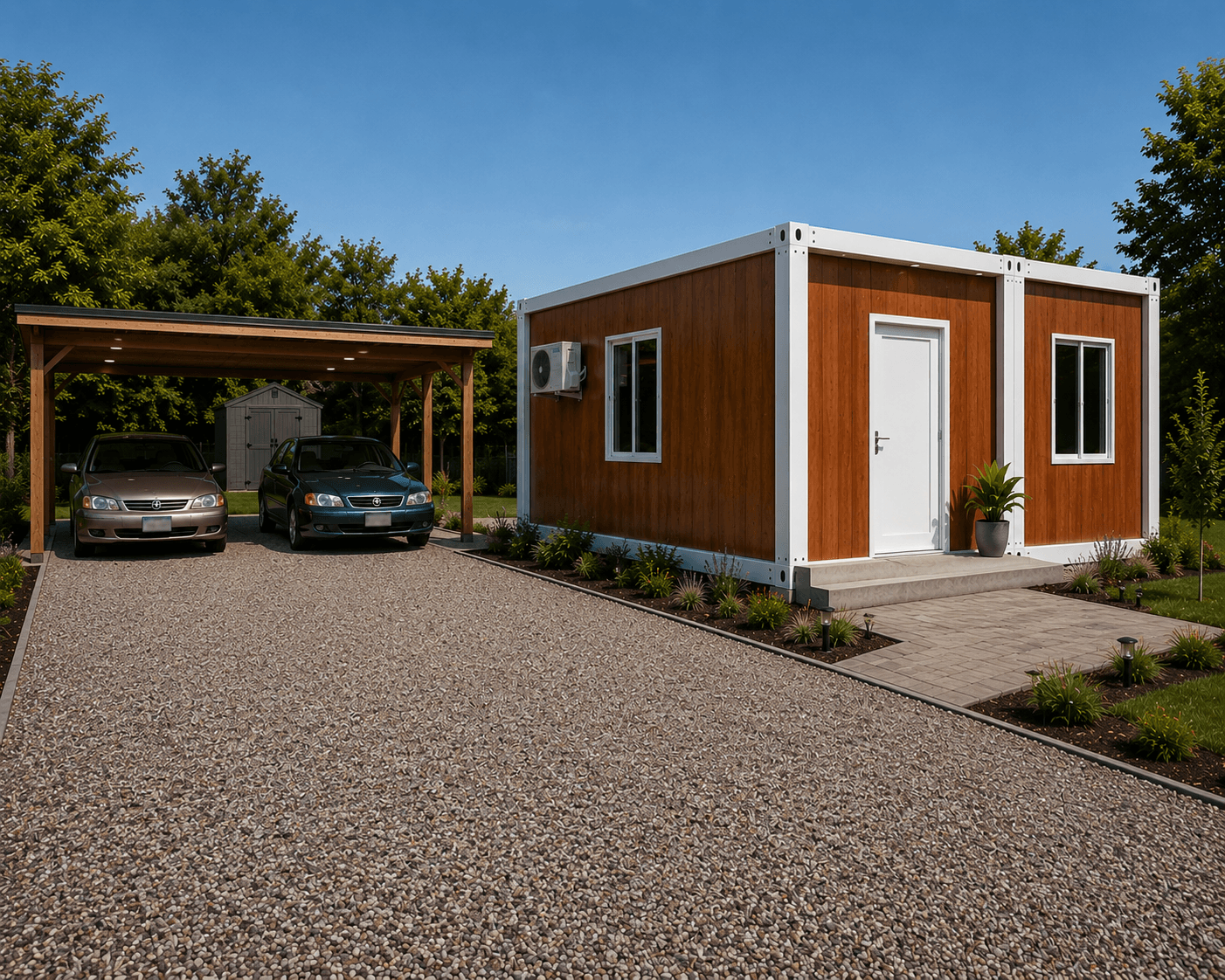
Electrical service is the single most misunderstood part of placing a prefab home, and the part most likely to produce an unwelcome surprise after the home is already on the ground. It is also entirely manageable once you understand one distinction. This guide covers that distinction and then walks through every situation we see: a standalone home on raw land, a backyard ADU behind an existing house, a second meter, and a fully off-grid solar setup.
The one distinction that explains everything: panel versus service
Your electrical panel is the metal box inside the home with the breakers in it. It distributes power to the circuits - lights, outlets, the HVAC, the water heater. Every Bright Box Home now ships with a 200-amp panel as standard equipment.
Your electrical service is something entirely different. It is the supply of power that arrives at the home from outside: the utility wires, the meter, and the conductors running from that meter to your panel. The service is not part of the home. It is arranged and installed on your site by you and your licensed electrician, working with your utility.
This is why the two numbers can differ. A 200-amp panel fed by a 100-amp supply gives you 100 amps of usable capacity. The panel rating is a ceiling, not a guarantee. Understanding that sentence will save you more money and frustration than anything else in this article.
So why do we ship a 200-amp panel if the feed might be smaller? Because the panel sets your ceiling permanently. A 200-amp panel with a large busbar and plenty of breaker spaces can accept solar, an EV charger, a generator interlock, and a shop circuit years later without replacing the panel. Feeding a large panel with a smaller supply is normal, common, and fully code-compliant. Undersizing the panel and discovering the limit three years later is the expensive mistake.
How much power does the home actually use?
Less than most people expect. A Bright Box Home is between 200 and 800 square feet, which means the lighting and general-outlet load is small. The loads that matter are the appliances: the mini-split heat pump, the induction cooktop, the electric dryer if you install one, and above all the water heater.
As an illustration only - your electrician performs the real calculation for your specific configuration and jurisdiction - a fully equipped 800 square foot home with a mini-split, an induction cooktop, a washer and electric dryer, and a modest point-of-use water heater typically calculates out somewhere in the range of 70 to 100 amps under the residential load method in the National Electrical Code. That is comfortably inside a 100-amp supply and generously inside 200.
Add one particular appliance, though, and the arithmetic changes completely.
The tankless water heater trap
Whole-house electric tankless water heaters are wonderful appliances and enormous electrical loads. A 24kW whole-house unit at 240 volts draws 100 amps. Not 100 amps occasionally - 100 amps whenever someone is taking a shower. Because the code treats that as a continuous load, the circuit feeding it must be sized at 125 percent of its rating, which means roughly 125 amps of capacity dedicated to hot water alone.
On a 100-amp supply, a 24kW electric tankless is simply not possible. On a 125-amp supply it consumes the entire service before a single light is switched on. This is the single most common electrical mistake in the small-home world, and it is why we now ship a 200-amp panel and recommend a 200-amp service for any home specified with a whole-house electric tankless.
You have three sensible paths. Install a 200-amp service and enjoy unlimited hot water. Choose a smaller point-of-use electric water heater, which uses a fraction of the power and suits a studio or one-bathroom home very well. Or use propane or natural gas for hot water, which removes the load from your electrical service almost entirely - often the smartest choice on rural land where a larger electrical service is expensive.
Talk to us about which water heater is specified on your build before you size your service. The two decisions are linked, and getting them out of order is what causes trouble.
Situation one: a standalone home on its own meter
This is the cleanest scenario. Your home is the only structure on the parcel, or at least the only one on this service, and the utility sets a meter for it. A 200-amp residential service is the standard offering from essentially every utility in the country for new construction, and in most cases getting one is routine.
The process generally runs like this. You contact the utility and request a new service, sometimes called a service application or a line extension request. They send someone to look at the site. They tell you where the point of connection will be, whether the service will be overhead or underground, and what you are responsible for providing. You hire a licensed electrician to install the meter base, the service conductors, and the grounding system to their specification. The utility connects their side, an inspector signs off, and the meter is set.
The timeline varies enormously. In a developed area with power already at the road, a few weeks is typical. On remote acreage requiring a line extension and an engineering study, several months is realistic. Start this conversation before your home is delivered, not after.
What a new service actually costs, and what drives the number
This is where budgets go wrong, so be specific with your utility and get the number in writing. The amperage itself is rarely the cost driver. Going from a 100-amp service to a 200-amp service usually adds a modest amount to the electrician bill - heavier conductors and a larger meter base - and often nothing at all to the utility charge. The distance and the terrain are what cost money.
The first driver is how far you are from existing utility lines. If power is already at the road in front of your parcel, you are looking at a straightforward service drop. If the nearest line is hundreds of feet away, the utility must extend their distribution to reach you, and you will typically pay for that extension. Costs commonly run into the thousands, and on genuinely remote rural land - a long private drive, a parcel set well back from the road, difficult terrain - a line extension can reach five figures. This is not unusual and it is not the utility being difficult. It is the real cost of building infrastructure across distance.
The second driver is overhead versus underground. Overhead service on poles is substantially cheaper. Underground service looks better and is protected from weather, but requires trenching, conduit, and often sand bedding and warning tape to code. Trenching cost depends entirely on what you are digging through. Soft soil is inexpensive. Caliche, rock, and tree roots are not. Rural Texas has plenty of both.
The third driver is transformer capacity. If the utility transformer serving your area does not have capacity for another home, they may need to upgrade it, and that cost can be passed along. This is the one most people never see coming, and it is worth asking about specifically.
The fourth driver is the meter location and the length of the run from the meter to your home. Conductors are priced by the foot and heavy conductors are not cheap. Positioning your home reasonably close to where the meter will sit saves real money.
Our honest advice: before you close on rural land, call the utility that serves that parcel and ask what a new 200-amp residential service would cost at that address. They will often give you a written estimate. That single phone call has changed more than a few of our customers minds about which parcel to buy.
Situation two: a backyard ADU behind an existing house
This is the most common use for our smaller models, and the scenario where the panel-versus-service distinction matters most. Your Bright Box Home goes in the backyard as an accessory dwelling unit, a guest house, an office, or a rental. In almost every case, it is not getting its own utility service. It is being fed from the existing house as a subpanel.
A subpanel is exactly what it sounds like: a panel fed from another panel rather than directly from the utility. Your electrician runs a feeder - typically four conductors, two hot, one neutral, one ground - from a breaker in the main house panel out to the home. That breaker determines your capacity. A 60-amp, 80-amp, or 100-amp feeder is typical for an ADU.
Here is the constraint. The existing house has its own service, often 100, 150, or 200 amps, and it is already using part of it. What is left over is what you can send to the ADU. Your electrician performs a load calculation on the existing home - adding up its actual demand - and determines how much spare capacity exists. A 200-amp house with a gas furnace, gas water heater, and modest loads may have plenty. A 100-amp house with electric heat and an electric range may have almost nothing to spare.
This is why a 200-amp feed to a backyard ADU is uncommon. It is not that the ADU cannot accept it - our panel certainly can. It is that the existing house usually cannot send it.
What to do if the existing service is too small
You have several options, in rough order of cost. First, reduce the ADU load. Choosing a point-of-use or gas water heater instead of a whole-house electric tankless can cut your required feeder nearly in half, and that single choice often makes an otherwise impossible project work.
Second, upgrade the main house service. Going from 100 amps to 200 amps at the existing home is a well-understood job involving a new meter base, new service conductors, a new main panel, and utility coordination. It is not cheap, but it is routine work for a residential electrician, and it improves the main house too.
Third, look at load management. Modern smart panels and load-management devices can allow a larger total connected load on a smaller service by preventing the biggest loads from running simultaneously. This technology has matured considerably and is worth asking your electrician about before assuming a service upgrade is necessary.
Fourth, request a separate service with its own meter.
Situation three: a second meter on the same property
Getting the utility to set a second meter for the ADU sidesteps the capacity problem entirely, and it has a real advantage if you are renting the unit out: the tenant gets their own bill. It is also the option most dependent on where you live.
Some utilities and jurisdictions allow a second residential meter on a single parcel without difficulty. Others prohibit it, or permit it only if the ADU is a legally permitted dwelling unit under local zoning, or require the parcel to be subdivided. Some will set a second meter but charge a monthly service fee for it regardless of usage. There is no national answer to this question, only a local one.
Two phone calls will resolve it: one to your utility asking whether they will set a second residential meter at your address, and one to your county or city planning office asking whether an ADU is a permitted use on your parcel. Make both calls before you commit to a plan.
Situation four: off-grid, where your inverter is your service
If you are going off-grid, there is no utility service at all, and the whole conversation changes. Your inverter becomes your service. Its continuous output rating is the practical equivalent of your main breaker.
Our 8kW solar package produces roughly 33 amps of continuous 240-volt output. The 10kW package produces roughly 42 amps. Those are your ceilings, and they are considerably smaller than a grid service - which is exactly why off-grid homes are designed differently rather than simply disconnected from the grid.
Off-grid design means avoiding large simultaneous electrical loads and shifting what you can to propane. A 24kW electric tankless water heater is completely incompatible with an off-grid system - it would need three times the entire output of a 10kW inverter. Propane handles hot water, cooking, and backup heat beautifully off-grid, and every kilowatt you move to propane is a kilowatt of battery and panel you do not have to buy.
Battery capacity is the other half. Panels produce during daylight; batteries carry you through the night and through cloudy days. Our 10kW package includes 20.48kWh of lithium iron phosphate storage, which covers a well-designed small home comfortably. Size this around your actual daily consumption in kilowatt-hours, not around a feeling.
The 200-amp panel still matters off-grid, because it gives you the breaker spaces to wire the inverter, a generator inlet, and a critical-loads arrangement without cramming.
Solar on a grid-tied home, and the rule that surprises everyone
If you are staying on the grid and adding solar, there is a code rule worth understanding before you choose an inverter size, because it catches almost everyone.
When solar feeds power into your panel, it does so through a breaker, and that power flows onto the same busbar that your main breaker feeds. To keep the busbar from being overloaded from both ends at once, the code limits the combination. In the most commonly used arrangement, the sum of the main breaker rating and the solar backfeed breaker rating cannot exceed 120 percent of the busbar rating.
Work that through on a 200-amp panel with a 200-amp main breaker. The busbar is 200 amps, 120 percent of that is 240 amps, and the 200-amp main already accounts for most of it - leaving only about 40 amps for solar backfeed. That is roughly a 7 to 8kW inverter. Our 10kW package would exceed it.
There are standard solutions and your solar installer will know them. The main breaker can be derated - replacing a 200-amp main with a 175-amp main frees up considerably more room for backfeed while still leaving far more capacity than a small home needs. The solar can be connected on the supply side of the main breaker, ahead of the panel entirely, which removes the limit. Or a combining panel can be used. None of these are exotic. But they need to be planned, not discovered.
This is the clearest illustration of why the panel we ship matters. The busbar rating of the panel sets the outer limit of everything you can ever add. A larger busbar means more room for solar, and that room is permanent.
Generators and backup power
Our generator-ready package provides an exterior generator inlet and the panel arrangement to use it safely. The critical component is the interlock: a mechanical device that makes it physically impossible for the generator breaker and the main breaker to be on at the same time.
That is not a formality. Without an interlock or a transfer switch, a generator can push power backward out onto the utility lines - a condition called backfeeding that can seriously injure or kill a lineworker repairing the outage you are generating through. Never connect a generator to a home without a proper interlock or transfer switch, and never use a cord with male plugs on both ends.
A portable dual-fuel generator in the 12 to 15kW range covers the essentials of a small home well. A permanently installed standby generator with an automatic transfer switch in the 18 to 22kW range runs the whole home automatically and starts itself when the power fails. Both need fuel planning: propane storage, natural gas supply, or gasoline rotation.
Permits, inspections, and who does what
The division of responsibility is consistent. We build and wire the home at the factory, including the panel, the circuits, the outlets, the lighting, and the fixtures. It arrives complete. You provide the service - everything from the utility to the point where it lands in the home - through a licensed local electrician.
That electrician pulls the electrical permit in nearly every jurisdiction. An inspector will typically want to see the service equipment, the grounding and bonding, and the connection into the home. Grounding deserves particular attention with a steel-framed home: the structure itself must be properly bonded, and this is not the place for improvisation.
If your parcel is in an unincorporated county with no building department, electrical permitting may be minimal or absent. That does not make the code optional in any meaningful sense - your insurer and any future buyer will both care whether the work was done correctly, and so will you the first time there is a storm.
The questions to ask before you buy anything
Ask your utility: what would a new 200-amp residential service cost at this address, is it overhead or underground, how far is the nearest distribution line, does the serving transformer have spare capacity, and will you set a second meter on this parcel. Ask for it in writing.
Ask your electrician, if you are feeding from an existing house: what is the calculated load on the existing service, how much spare capacity is there, what size feeder can you run to the ADU, and what would a service upgrade cost if we need one.
Ask your county: is an ADU a permitted use on this parcel, is an electrical permit required, and is there a separate utility connection permit.
Ask us: which water heater is specified on my build, what is the calculated load for my configuration, and does my planned solar package fit the panel as configured. These are the questions that determine your service size, and we would far rather answer them before your home is built than after it is delivered.
A note for rural Texas buyers
Much of our business is on unrestricted rural acreage in Texas, and the pattern there is consistent. Land is affordable and restrictions are light, which is exactly why people choose it - and the utility connection is frequently the largest single site-cost variable in the entire project. A parcel a quarter mile off the road with no power at the property line can cost more to electrify than the difference in price between two of our models.
That is not a reason to avoid rural land. It is a reason to price the electrical connection as part of the land decision rather than after it. Two otherwise identical parcels can differ by five figures on this line item alone, and the listing will never tell you which is which.
It is also why off-grid deserves genuine consideration rather than being treated as a fallback. If a utility extension is quoted at five figures, that same money buys a substantial solar and battery system that comes with no monthly bill attached. Run both numbers before you assume the grid is the default.
The short version
Every Bright Box Home ships with a 200-amp panel, which sets your ceiling permanently and leaves room for solar, EV charging, and a generator. The service that feeds it comes from your site, and its size depends on your situation: a full 200-amp service for a standalone home on its own meter, typically a 60 to 100-amp subpanel feed for a backyard ADU, or an inverter-defined capacity off-grid. The water heater choice drives the requirement more than anything else. And the cost of the connection is driven by distance and terrain, not amperage.
Get a written utility quote before you buy land, have your electrician run a load calculation before you order, and tell us your situation so we can specify the home to match it. Explore our expandable container homes from $35,995, review the solar and generator packages on any product page, and talk to our team - we would rather spend an hour on your site plan now than troubleshoot it later.